

The future of urban mobility is rapidly evolving, and driverless public transport stands at the forefront of this revolution. As cities grapple with congestion and environmental concerns, autonomous vehicles offer a promising solution to enhance efficiency and accessibility. Imagine hopping onto a self-driving bus that navigates through traffic seamlessly, providing a reliable and eco-friendly alternative to traditional transportation.
With advancements in technology and increasing investments in smart infrastructure, the concept of driverless public transport is becoming a reality. This shift not only aims to improve the daily commute but also to reshape how communities connect and thrive. As cities explore this innovative approach, understanding its implications and potential benefits becomes essential for both policymakers and commuters alike.
Overview Of Driverless Public Transport
Driverless public transport includes autonomous vehicles designed to operate without human intervention. This innovative approach seeks to address urban transportation challenges such as congestion, accessibility, and emissions.
Driverless buses and shuttles represent the most prominent examples, employing advanced technologies like LiDAR and computer vision for navigation. These technologies enable vehicles to perceive their surroundings, make real-time decisions, and ensure passenger safety.
Current deployments of driverless public transport can be found in various cities globally. For instance, Las Vegas and San Francisco have pilot programs utilizing autonomous shuttles for local routes. These implementations showcase the feasibility of integrating driverless solutions into existing public transport networks.
Autonomous systems promise to enhance efficiency and reliability in transit operations. They can operate on-demand, optimizing routes based on real-time passenger data. Additionally, integrating driverless vehicles with smart city infrastructure supports better traffic flow and reduces overall transit times.
Policymakers must consider regulatory frameworks accommodating this technology. Establishing safety standards and public acceptance strategies is crucial for fostering widespread adoption.
The environmental benefits of driverless public transport are significant. Autonomous vehicles often operate with electric power, contributing to lower emissions. Enhanced efficiency can also lead to reduced energy consumption, further benefiting urban air quality.
Understanding the potential implications of driverless public transport informs future developments. As technology advances, the impact on community connections, urban planning, and economic growth will become more pronounced.
Benefits Of Driverless Public Transport
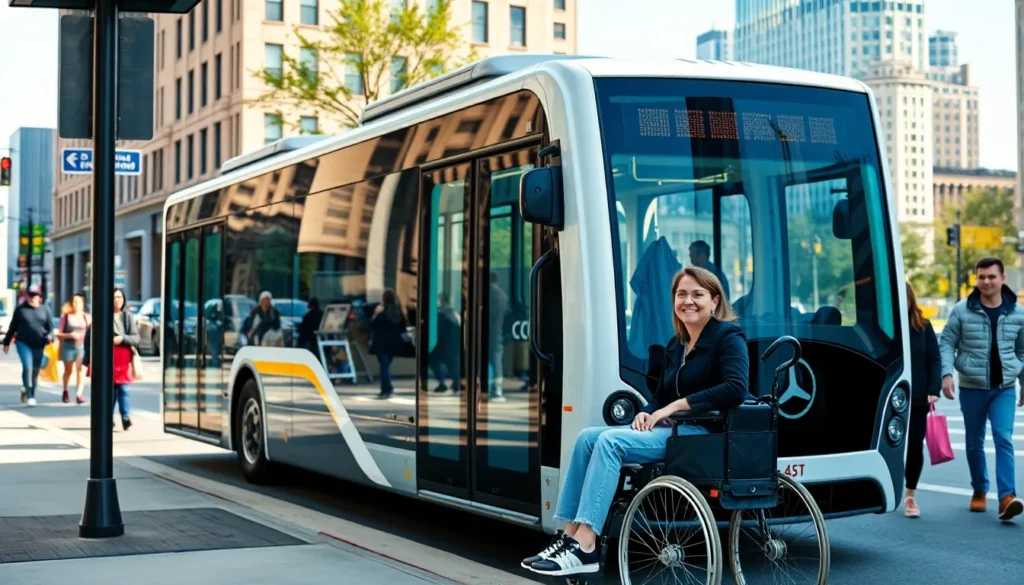
Driverless public transport presents numerous advantages, enhancing urban mobility and contributing to greener cities. Key benefits include increased safety and enhanced accessibility.
Increased Safety
Autonomous vehicles decrease the likelihood of accidents caused by human error. Studies reveal that up to 94% of traffic accidents stem from these errors. Driverless systems incorporate advanced technologies like LiDAR and computer vision to continuously assess surroundings. By processing real-time data, these vehicles can react to potential hazards more effectively than human drivers, thereby reducing collision rates. Additionally, the incorporation of features such as automatic braking and obstacle avoidance signifies a further commitment to passenger safety.
Enhanced Accessibility
Driverless public transport significantly improves accessibility for diverse populations. Autonomous vehicles can operate in various environments, including urban and suburban areas with limited access to traditional transit. This accessibility benefits individuals with disabilities, offering them improved mobility options. Moreover, on-demand services allow communities to tailor transport solutions based on specific needs, enhancing overall public transit availability. Cities can implement specialized routes that adapt to demand, ensuring even underserved areas receive vital transportation services.
Challenges And Concerns
Driverless public transport faces several significant challenges and concerns that must be addressed to foster widespread adoption. Key issues include technical limitations and public acceptance.
Technical Limitations
Driverless technology confronts various technical limitations impacting its deployment in public transport. Sensor performance can vary under different weather conditions, affecting vehicle perception and navigation. Systems relying solely on LiDAR might struggle during heavy rain or fog, leading to potential safety risks. Furthermore, existing infrastructure may require significant upgrades to support autonomous vehicles, particularly for reliable communication networks.
In addition, software limitations can hinder the responsiveness of autonomous systems in complex urban environments with unpredictable human behaviors, such as pedestrians and cyclists. Ensuring seamless integration with traditional vehicles remains a challenge, as mixed traffic scenarios could lead to increased risks. These technical hurdles necessitate ongoing research and development efforts to enhance reliability and safety standards.
Public Acceptance
Public acceptance serves as a crucial factor in the implementation of driverless public transport. Many individuals express concerns regarding safety, trusting autonomous vehicles over human-driven ones. Misinformation and fear of technology can further complicate this issue, as anecdotal incidents involving autonomous vehicles may create doubt among potential users.
Furthermore, cultural and demographic factors influence acceptance levels across different populations. Younger generations may exhibit a higher willingness to embrace autonomous technology, while older individuals might resist due to unfamiliarity or perceived risks. Building public trust requires transparent communication efforts, including educational initiatives that demonstrate the safety benefits and proven successes of autonomous transport systems.
Addressing these concerns effectively is essential for promoting the integration of driverless public transport into urban mobility strategies.
Case Studies Of Driverless Public Transport
Driverless public transport exhibits significant global implementations and success stories that demonstrate the technology’s potential. Various cities are pilot-testing these autonomous systems to assess usability, safety, and efficiency.
Global Implementations
Numerous cities around the world are implementing driverless public transport systems to improve urban mobility.
- Las Vegas, Nevada: A self-driving shuttle operates on a fixed route, covering approximately 0.6 miles and connecting visitors to key attractions. This pilot showcases autonomous transit in a high-traffic area.
- San Francisco, California: Companies like Waymo and Cruise are deploying self-driving taxis and shuttles, integrating them into urban environments to gauge real-world performance.
- London, England: The UK’s first fully autonomous bus service commenced trials, emphasizing its potential in reducing congestion and air pollution.
- Singapore: The city-state tests autonomous shuttles in residential areas, focusing on enhancing first and last-mile connectivity.
These implementations provide insights into the technology’s efficacy and community acceptance while addressing transportation gaps.
Success Stories
Several trials and projects exhibit the success of driverless public transport in various settings.
- Gothenburg, Sweden: The AURA project features autonomous buses operating in mixed traffic, successfully transporting passengers and receiving positive feedback for reliability and safety.
- Utrecht, Netherlands: The RoboBus project combines ride-sharing and driverless technology. This system effectively connects passengers with public transport, demonstrating smooth integration into existing networks.
- Daejeon, South Korea: The city launched autonomous electric buses, showcasing impressive ridership within their designated areas and promoting green transportation solutions.
These success stories illustrate how driverless public transport can enhance system efficiency and attract public interest, fostering a shift towards more sustainable urban mobility solutions.
Future Of Driverless Public Transport
The future of driverless public transport promises enhanced efficiency and sustainability in urban environments. Autonomous vehicles, such as buses and shuttles, will increasingly integrate with existing transport networks, offering seamless connectivity and convenience for passengers. Advanced technologies, including artificial intelligence and machine learning, will further refine route optimization and operational efficiency.
Driverless systems will adapt to real-time traffic patterns and demand, minimizing wait times while maximizing passenger satisfaction. The potential for on-demand services will redefine public transport paradigms, allowing users to access rides tailored to their specific needs.
Infrastructure improvements will complement these developments, as smart city initiatives incorporate vehicle-to-infrastructure (V2I) communication to facilitate traffic management and safety enhancements. These integrated systems will play a critical role in managing congestion and reducing transit times, ultimately improving commuter experiences.
To realize this vision, policymakers must implement supportive regulatory frameworks that prioritize safety, public trust, and data privacy. This regulatory landscape will help address safety standards and liability issues surrounding autonomous operations. Engaging communities in discussions about the future of transportation will foster confidence in driverless solutions and their societal benefits.
As cities embrace driverless technology, the continued focus on environmental sustainability remains crucial. Electric and hybrid autonomous vehicles will contribute to lower emissions and improved urban air quality, promoting healthier living conditions for residents.
The future also holds promise for increased accessibility. Driverless public transport systems will specifically enhance mobility for underserved populations, including the elderly and individuals with disabilities. Tailored solutions can bridge gaps in service coverage, ensuring that all community members benefit from advances in transportation technology.
Overall, the trajectory of driverless public transport indicates a transition toward smarter, greener, and more inclusive urban mobility systems. Engaging collaboratively across sectors will maximize the joint potential of technology, policy, and community input, driving urban evolution in public transport solutions.
Driverless public transport stands at the forefront of urban mobility innovation. Its potential to transform cities into greener and more efficient spaces is undeniable. By leveraging advanced technologies and integrating with existing infrastructure, autonomous vehicles can enhance safety and accessibility for all.
Addressing challenges such as public acceptance and technical limitations will be vital for successful implementation. Engaging communities and fostering trust in this technology will pave the way for broader adoption.
As cities continue to pilot and refine these systems, the future looks promising. Driverless public transport could redefine how communities connect and thrive, ensuring that urban environments are not only smarter but also more inclusive and sustainable.